| Author |
Message |
    
Mike Watts
| | Posted on Sunday, 21 June, 2009 - 7:57 pm: | |
I think the article referenced is interesting but not for working out the physics of the line of draught.
In particular it asserts that the line of draught must pass through the centre of gravity for a person or horse to remain in balance. That is not the case. Consider the simple example of a person pulling a load - the article asserts "We have to draw the weight of the load through our own centre of gravity, so that we remain in balance." That is simply wrong. In order to remain in balance, the moment of the person's weight about their feet must equal the moment of the pull for whatever they are pulling, as in this idealised diagram.
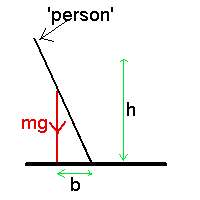
For balance, we simply require mgb = Th, where m is the person's weight, b the lean, T the pull and h the height off the ground - I show a simple horizontal pull to avoid complicating.
...the line of draught may well turn out to be most comfortable or convenient where it is shown, but this will more likely be for biomechanical reasons; in mechanical terms there is nothing magic about pulling through the centre of gravity.
The references cited in the article give a little more information, but certainly the experiment did not indicate the line of draught having to go through the centre of gravity - on the contrary, it found the draught angle changing with loading. reference
I offer this as a contribution to the physics only! |
Janet Pilling
| | Posted on Saturday, 20 June, 2009 - 9:00 pm: | |
Chris - this link explains things very well.
http://www.northwest.f9.co.uk/balanced-draught.htm |
Christopher Priestley
| | Posted on Friday, 19 June, 2009 - 11:38 pm: | |
Can someone please explain to me how the line of draught works? The more scienfic the explanation the better!
I only half get it. And it's bothering me.
And if you could explain it for four wheelers too, that'd be great. |
|
 Closed: New threads not accepted on this page